
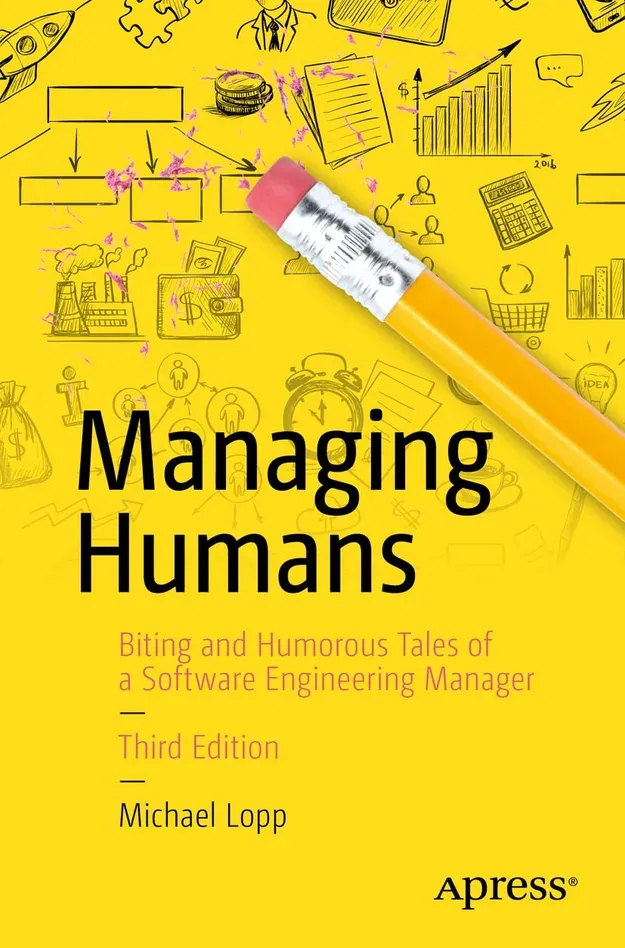
Managing Humans
Biting and Humorous Tales of a Software Engineering Manager
Author: Michael Lopp
If you manage people, this book is worth reading. Rather than offering complete solutions, it presents the author’s gut feelings based on his experience with what works and what doesn’t. It’s written lightly, with plenty of humor and healthy doses of sarcasm that make it engaging without being cynical.
Several topics have stayed with me well after finishing this book.
Phlegmatic vs Spitfire
The book describes a compelling dynamic: ambitious, energetic team members become phlegmatic over time after repeated conflicts. They shift their focus to establishing standards and protecting the status quo rather than fighting for new initiatives. Meanwhile, newly hired team members arrive as spitfires, eager to prove themselves, change things, and improve processes. These two types are natural adversaries, and without proper management, they can create significant organizational turmoil.
A leader’s role is to channel their conflicting energies productively. Rather than suppressing either type, guide them toward innovation in different areas where their approaches complement rather than compete. Let spitfires challenge and rebuild in one domain while phlegmatics stabilize and refine in another.
I recognize myself in the spitfire profile. I build things, standardize processes, and the moment others begin treating those standards as immutable law, I find myself questioning them, pushing back against complacency, and seeking improvements. Managing continuous change has become a defining part of my leadership practice.
How to lead and (not) attend meetings
Good meeting leadership begins with understanding who actually belongs in the room. Lopp divides participants into two types: players and pawns. Players are the active contributors who have real influence on the outcome. Pawns are people who may need to execute later, but in this meeting they add little value.
Players want to “play” - they bring energy, arguments, and pressure. Pawns are often capable people elsewhere in the organization, but in this context their role is passive. If their presence only creates noise, a strong meeting owner should politely keep them informed rather than turning the session into a status update for them.
Lopp shares a healthy disdain for many status meetings that could be handled in email. He offers practical hacks for avoiding or leaving pointless meetings early: clarify the meeting’s purpose, ask whether decisions will be made, and confirm whether your attendance is truly required.
When a meeting does matter, he warns against political traps. Some participants may appear to agree with you just to draw you into a change they actually plan to block later. He even references The 48 Laws of Power - not as a playbook to emulate, but as a lens for recognizing manipulation.
One More Thing
Beyond these specific frameworks, what struck me most is the book’s underlying philosophy: managing humans requires both structure and flexibility. Rules, standards, and processes provide the foundation, but your people give them meaning. The best managers I’ve observed share Lopp’s belief that leading people is fundamentally a craft learned through experience, reflection, and honest mistakes.